
SERVICES
Trusted Pediatric Dentist in Trivandrum
for Kids' Smiles
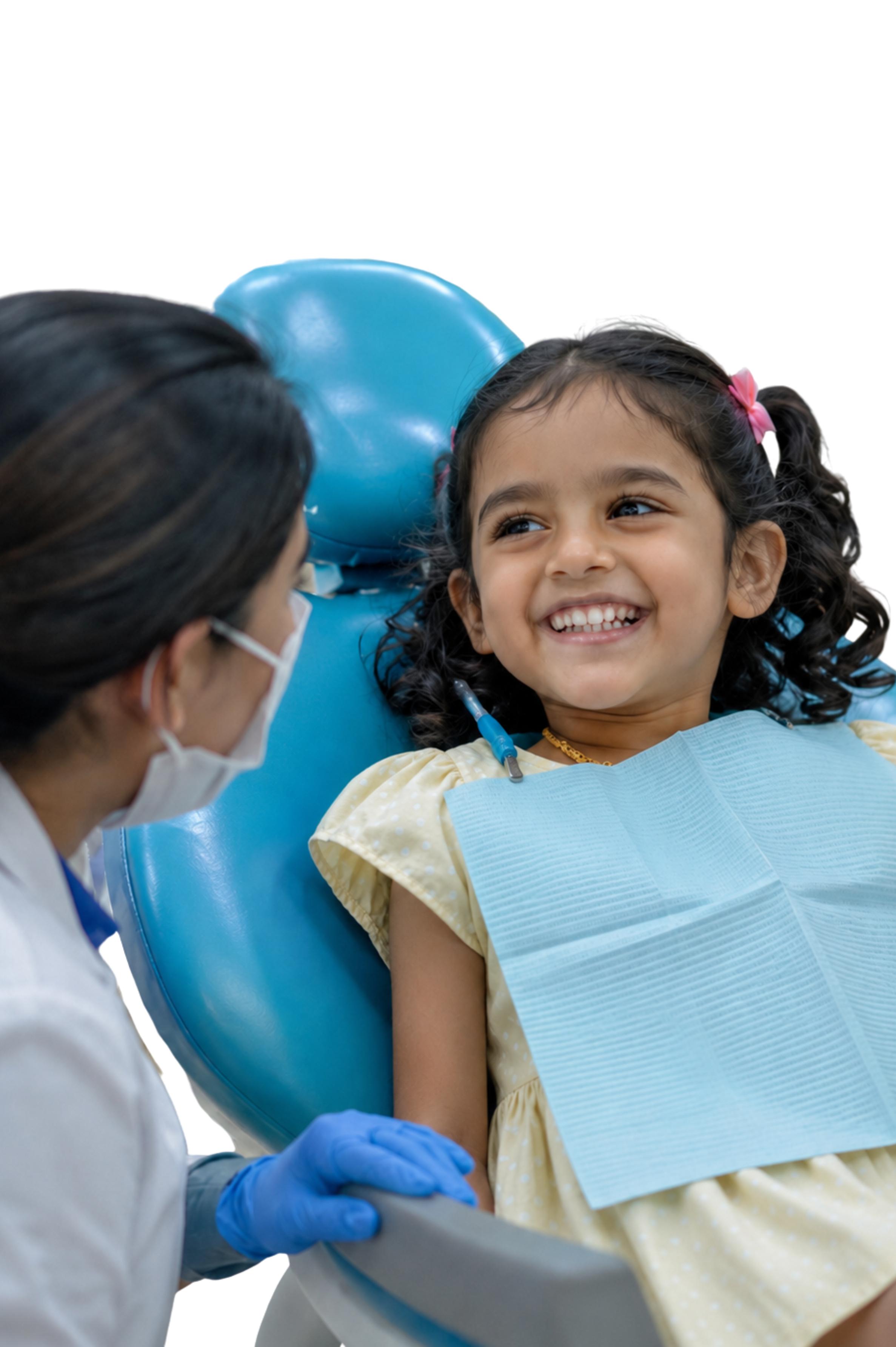
A child’s mouth does not behave like a small adult mouth.
That is where parents get caught. A milk tooth looks temporary, so the pain gets treated as temporary too. A black spot is watched. A swelling is given warm salt water. A loose tooth is celebrated even when it is loose too early. Then the child reaches the clinic tired, frightened, half-fed, with pain that has been running for weeks.
Pediatric Dentistry in Trivandrum has to be understood in that setting. Not as a fancy branch of dentistry. Not as a room with cartoon stickers. It is dental care shaped around children who may cry before they sit, bite when scared, hide pain from parents, or suddenly become brave when nobody expects it.
In Kerala, parents are usually alert about fever, cough, skin allergy, school marks, food habits. Teeth still come late on the worry list. Sometimes much too late. The child eats on one side for months and the family thinks it is a habit. The child refuses rice, asks for soft dosa, takes more curd rice, avoids crunchy food. Nobody connects it to a painful molar until there is swelling near the gum.
A trusted children’s dentist notices those small things. The chewing pattern. The way the child keeps the lips open. The grey front tooth after a fall six months ago. The mother saying, “He brushes daily,” while plaque sits thick along the gumline. Not because anyone is careless. Because brushing a child’s teeth properly is harder than people admit.
Especially at night.
The last brushing matters more than the morning brushing in most children with decay. That is not a popular line, because morning brushing feels cleaner and more visible. Night brushing is where the real battle is. Sleepy child. Busy parent. Milk bottle. Story time. School bag still not packed. A quick rinse feels enough.
It is not enough.
A Pediatric Dentist in Thiruvananthapuram who works regularly with children will usually spend more time asking about routine than looking at the cavity itself. What time does the child sleep? Is milk given after brushing? Does the child hold food in the mouth? Are biscuits used as a peace offering during tuition travel? Is there packed juice in the school bag? Does the child breathe through the mouth at night? Does the child snore?
These questions are not extra conversation. They decide whether treatment will last.
A filling placed in a dry, cooperative mouth can do well. A filling placed in a wet, crying mouth may fail early. A crown on a badly broken milk molar can last until the tooth falls naturally. The same crown may come loose if the child grinds heavily, keeps chewing sticky sweets, or returns to night feeding. Fluoride varnish can help, but it cannot cancel frequent sugar exposure. Sealants protect grooves, not the entire child.
That is the part parents should hear plainly.
Good paediatric care is not just gentle treatment. It is honest risk control.
Early Signs, First Visits and Dental Fear
Child Dental Care in Trivandrum often starts too late because parents wait for pain. Pain is a poor alarm in children’s dentistry. Some deep cavities stay quiet until the nerve is badly infected. A child may not say “tooth pain”; they may say the food is hot, the rice is hard, the cheek feels funny, or they may just stop eating properly. Very young children cry at night and point nowhere. Parents then suspect worms, ear pain, throat pain, hunger, stubbornness.
The tooth is not always dramatic.
Sometimes it is a small brown line between two back teeth.
The first visit should not be after a sleepless night. Ideally, it happens when the first tooth appears or by the first birthday. That sounds early to some families. In practice, the first visit is not about drilling or treatment. It is about catching feeding mistakes, checking enamel defects, guiding brushing, looking at jaw growth, and helping the child treat a dental clinic as a normal place before fear gets attached to it.
Fear is learned quickly.
Parents often prepare children badly with good intentions. “Don’t be scared.” “No injection.” “The doctor will not do anything.” “If you cry, I will leave.” “Just open your mouth, it is nothing.”
A child hears scared, injection, doctor, cry, leave.
Better to say less. “The dentist will count your teeth.” “We will sit together.” “You can hold my hand.” Then stop talking.
Some children need a slow first appointment. Some need firmness. Some need treatment split into shorter visits. Some are better in the morning before school fatigue. Some behave better without grandparents in the room. A few behave better when the parent is not leaning over the chair explaining every movement. This is not disrespect to parents. Children perform fear when the audience is anxious.
A good Kids Dental Clinic in Trivandrum should not look only at the tooth. The clinic should be set up for behaviour, timing, space, suction noise, gag reflex, small instruments, and the parent’s anxiety. A child who is pushed through treatment once may remember it for years. A child who is given endless negotiation may also become impossible to treat.
Too soft fails. Too forceful fails.
The work sits somewhere in between.
Why Milk Teeth Deserve Serious Care
Milk teeth deserve more respect than they get. They help chewing, speech, jaw growth, face balance, and space for permanent teeth. When a milk molar is lost too early, the neighbouring teeth can drift. Later, the permanent tooth may not get enough room. Parents then ask why orthodontic treatment became necessary. Sometimes the beginning was a decayed milk tooth that nobody wanted to restore because “it will fall anyway.”
Yes, it will fall.
But not always next week.
Some back milk teeth are needed until around ten to twelve years of age. A four-year-old with a badly decayed second milk molar still has years to go. Removing it casually is not conservative treatment. Saving it may need a pulpotomy, pulpectomy, stainless-steel crown, or another child-safe restorative option. Not glamorous. Very useful.
A pulpotomy is often misunderstood. Parents hear “root canal” and panic. In children, treatment inside a milk tooth is different from adult root canal treatment. The aim is to remove infected or inflamed tissue, control pain, keep the tooth functional, and avoid unnecessary extraction. It can fail if infection has already spread badly, if the tooth is too broken, if the child cannot tolerate isolation, or if follow-up is ignored. No dentist should promise magic on a tooth that has already abscessed twice.
Cavities between children’s back teeth are another problem. Parents cannot see them easily. The chewing surface may look fine from above. Food gets stuck. The child complains only when sweets touch the area. By the time the side cavity is visible, it may already be deep. Dental X-rays help here. Not for every child at every visit, but when risk is high or the contact areas cannot be checked properly.
Parents sometimes resist X-rays because the child is small. That caution is understandable. Still, avoiding a needed dental X-ray can lead to under-treatment. Modern dental radiographs use limited exposure, and they are taken only when the information changes care. Guesswork is not safer just because it feels natural.
Food Habits, Fluoride and Daily Prevention
Pediatric Dentistry in Trivandrum also has to deal with food culture honestly. Kerala homes are not short of soft carbohydrates. Appam, puttu, dosa, bread, banana chips, bakery snacks, sweet tea, flavoured milk, payasam during functions, biscuits after school, chocolate as a reward, syrup medicines, health drinks that are treated like nutrition but behave like sugar in the mouth. The issue is not one sweet. It is frequency. A child who eats one sweet after lunch and then drinks water is different from a child who nibbles biscuits five times a day. Teeth tolerate attacks poorly when they come again and again. Parents ask whether jaggery is safer than sugar. For teeth, sticky sweetness is still a problem. Dates are natural, yes. They can still cling to molars. Honey is natural. It can still feed decay bacteria.
This is where common advice becomes too neat. “Avoid sweets” is not realistic. Children attend birthdays, school events, temple functions, family visits. A better rule is to keep sweet food with meals, reduce between-meal snacking, avoid sweet drinks in bottles, brush properly at night, and use preventive dental care based on the child’s risk.
Fluoride is another subject where fear spreads faster than facts. Used correctly, fluoride toothpaste and fluoride varnish are valuable in preventing decay. The quantity matters. A smear or rice-grain amount for very young children. A pea-sized amount when the child is older and can spit. Parents should not let children swallow toothpaste like cream. They also should not avoid fluoride completely when the child is getting repeated cavities.
The mistake is not fluoride. The mistake is careless use or complete rejection without understanding the child’s risk.
Fissure sealants are useful when permanent molars erupt with deep grooves. These teeth usually appear around six years of age, behind the last milk molars. Parents miss them because no tooth falls out before they come. The new molar sits at the back, partly covered by gum for a while, difficult to brush, easy to decay. A sealant can block the groove before decay starts. It needs review. It can chip. It can wear. It is still a sensible preventive step for the right child. Brushing technique is less charming than people think. Children below six or seven usually do not brush well alone. They move the brush, create foam, smile proudly, and still leave plaque behind. Parents need to brush for them or at least finish the brushing. The back molars, gumline, and inner surfaces are commonly missed. Electric brushes can help some children, but not if the parent treats the device as a substitute for supervision. Bleeding gums are another trap. Parents stop brushing the bleeding area because they think the brush injured the gum. Often the gum is bleeding because plaque has been sitting there. Gentle, proper cleaning is needed. If bleeding continues, the dentist should check. Thumb sucking, mouth breathing, tongue thrusting, nail biting, and long pacifier use can change tooth position and jaw development. Not every habit needs aggressive treatment. Timing matters. A three-year-old thumb sucker and a seven-year-old thumb sucker are not the same. Scolding rarely helps. Bitter liquids may create drama and no correction. Habit appliances may work, but only when the child and parents are ready. If the airway is the real issue, forcing the mouth closed is not treatment.
Falls are common in children, and front teeth suffer. A baby tooth that turns grey after trauma should be checked, even if the child has no pain. Sometimes it remains stable. Sometimes infection develops later. A permanent tooth that breaks, loosens, or comes out needs urgent dental care. Parents should not scrub an avulsed permanent tooth. They should seek emergency dental advice quickly. Time matters sharply in dental trauma.
Treatment Decisions, Emergencies and Choosing the Right Clinic
Pediatric Dentistry in Trivandrum should include emergency planning, not just scheduled fillings. Toothache, swelling, broken teeth, knocked-out teeth, bleeding after injury, ulcers that stop eating, braces-related cuts, and infections in medically vulnerable children need clear handling. A paediatric dentist can treat many emergencies, but not all emergencies belong in a routine dental chair. Facial swelling with fever, difficulty swallowing, breathing difficulty, or a very ill-looking child needs urgent medical attention.
Children with autism, sensory sensitivities, developmental delay, heart conditions, bleeding disorders, seizure history, or severe anxiety need more careful planning. Sometimes the first appointment is only for familiarisation. Sometimes treatment needs sedation. Sometimes hospital-based care is safer. Pretending every child can be managed with cheerful talk is unfair to the child and the dentist.
Parents also need to be honest about medical history. Inhalers, allergies, previous hospital admissions, heart murmurs, regular medicines, snoring, delayed milestones, fainting episodes, bleeding problems, and past reactions to local anaesthesia matter. Even if the appointment is “just for teeth”.
Local anaesthesia is another place where language matters. A child does not need a lecture on needles. They need calm handling. Numbing gel, slow technique, distraction, and steady support can make a big difference. Still, some children cry. Crying does not always mean pain. It can mean pressure, fear, tiredness, loss of control, or anger. The dentist has to judge that carefully, not dismiss it.
Restorations in children are not judged only by beauty. Parents often want tooth-coloured fillings everywhere. Fair enough. In front teeth, appearance matters. In back teeth with heavy decay, stainless-steel crowns may be more reliable than large white fillings. They are silver. Parents may dislike the look. The child usually cares less than the adults. A crown that protects a weak milk molar for years can be the better choice.
White crowns exist in some settings, but they need more tooth reduction, careful bite selection, and higher cost. They are not automatically better.
The best treatment is the one that suits the tooth, the child, the risk, the budget, and the likelihood of follow-up.
A trusted clinic should explain options without frightening parents into the costliest choice. It should also not under-treat a child just to keep the visit pleasant. A shallow cavity and a deep cavity are not the same. A cooperative eight-year-old and a terrified three-year-old are not the same. A child with one cavity and good brushing is not the same as a child with eight cavities and night milk.
Pediatric Dentistry in Trivandrum works best when parents accept that prevention is an active plan. Reviews every six months may suit some children. High-risk children may need shorter intervals. A child with no cavities, good saliva flow, good brushing, and sensible food habits does not need the same schedule as a child with enamel defects, frequent snacks, and early decay.
Enamel defects are worth mentioning. Some children’s teeth erupt with chalky white, yellow, or brown patches. The tooth may be sensitive from the beginning. Parents may think the child damaged it after eruption. Sometimes the problem formed while the tooth was developing. These teeth can break down fast. They need early protection. Waiting for a neat cavity to appear is a poor plan.
Bad breath in children is not always dental, but dental causes are common enough. Plaque on the tongue, decayed teeth, food trapped between molars, gum inflammation, mouth breathing, and poor cleaning around erupting teeth can all contribute. If the mouth is clean and the smell continues, throat, sinus, reflux, and other causes may need attention.
Parents sometimes ask for tooth whitening for children. Usually, that is the wrong question. A child’s permanent teeth naturally look more yellow than milk teeth when they erupt next to them. Stains from food, iron syrup, chromogenic bacteria, or plaque can often be cleaned. Bleaching young teeth without a clear reason is rarely the answer. First check the cause.
Dental care also affects confidence. A child with black front teeth may stop smiling in photographs. A child with bad breath may be teased. A child with untreated molar pain may struggle to eat during school hours. These are not cosmetic concerns alone. They touch speech, sleep, appetite, concentration, and social comfort.
Still, not every crooked tooth needs early treatment. Parents now come worried after seeing a slightly rotated lower incisor in a six-year-old. Some crowding can be monitored. Some needs early interceptive orthodontic care. The difference depends on space, bite, jaw pattern, habits, airway signs, and eruption sequence. Early treatment is useful when it prevents a bigger problem. It is wasteful when started only because everyone is anxious.
The same applies to tongue-tie. It has become a fashionable diagnosis in some circles. A true tongue restriction can affect feeding, speech, oral hygiene, or function. Not every heart-shaped tongue needs a laser release. The decision should be functional, not just visual. A child who speaks well, eats well, moves the tongue well, and has no related problem may not need anything done.
Trust in a paediatric dentist comes from judgement. The ability to say yes, no, wait, watch, treat now, refer, or stop.
Parents should watch how the dental team speaks to the child. Not baby talk throughout. Not threats. Not lies. Children can handle simple truth when it is given calmly. “This will feel like water.” “This will feel noisy.” “Your tooth is sleeping now.” “Raise your hand if you need a break.” Those small phrases matter.
The clinic should also explain home care in a way a family can follow. Advising perfect brushing, zero sugar, and flawless follow-up is easy. Real homes are messier. Working parents. Grandparents giving sweets secretly. School canteen snacks. Children who sleep in the car. Children who vomit when brushed. Children who chew the brush. Children who refuse toothpaste flavour. The plan has to survive all that.
For a toothpaste-hating child, change the flavour before giving up. For a child who bites the brush, use two brushes: one for the child to hold and one for the parent to clean. For a child who runs away, brush while they lie down, head supported, with better visibility. For a child who wants independence, let them brush first, then the parent “checks the hidden teeth”. Small tactics. They save teeth.
Pediatric Dentistry in Trivandrum should feel local, practical, and steady. A parent from Kazhakootam fighting traffic for an evening appointment with a hungry preschooler may get a very different result from the same child seen after breakfast on a calmer day. Timing is treatment. So is sleep. So is whether the child has been promised ice cream after the visit.
Bribes are tricky. A small reward after cooperation is fine. A big bribe before treatment gives the child power to bargain. “Open your mouth and I will buy a toy” can become “I will open only if the toy is bigger.” Praise works better when it is specific. “You kept your hands still.” “You opened even when the water was noisy.” That builds behaviour for the next visit.
A trusted paediatric dental visit should leave the parent clearer, not just relieved. Which teeth are at risk? Which treatment is urgent? Which can wait? What happens if nothing is done? How long should the restoration last? What could make it fail? When should the child return? What should parents watch for at home?
Those answers matter more than a smiling reception photo.
FAQ
What treatments are included in pediatric dentistry?
Preventive care, fluoride application, fissure sealants, tooth cleaning, cavity fillings, pulp treatment for infected milk teeth, stainless-steel crowns, tooth-coloured restorations, space maintainers, habit counselling, trauma care, emergency pain relief, early bite assessment, gum care, and dental guidance for children with special healthcare needs. The exact treatment depends on the child’s age, cooperation, decay risk, tooth condition, and medical background.
What Are the Common Dental Problems in Children?
Tooth decay comes first in most clinics. Then pain from deep cavities, food lodgement, broken front teeth after falls, stains, bleeding gums, early loss of milk teeth, delayed eruption, crowded teeth, thumb sucking effects, mouth breathing signs, ulcers, bad breath, and sensitivity in newly erupted permanent molars. Some children have enamel defects that make teeth weak from the start. Those teeth need attention before they collapse.
What makes early dental check-ups essential for children?
Early visits catch problems before they become painful. They also help parents correct feeding, brushing, toothpaste use, and snack frequency while the damage is still preventable. The first visits are usually simple when the child is brought early. Waiting until pain begins makes the first dental memory harder, and sometimes the tooth is already too damaged for a small filling.
What are the benefits of pediatric dental care for kids?
The child gets care suited to age, fear level, growth, and behaviour. Pain is managed earlier. Milk teeth are protected when they still have years of function left. Permanent molars can be sealed before decay starts. Parents get a clearer home plan. The child learns that a dental visit is normal, not a punishment that happens after sweets or poor brushing.
What is pediatric dentistry?
It is dentistry for infants, children, and teenagers, including children who need extra medical, emotional, or developmental support. It covers prevention, diagnosis, treatment, habit guidance, dental growth, trauma care, and behaviour management. The child is not treated as a smaller adult. The treatment plan is built around growth, cooperation, family routine, and long-term oral health.
At what age should my child first visit a dentist?
The first visit should happen when the first tooth appears or by the first birthday. That early visit is usually short. The dentist checks the mouth, looks for risk factors, guides brushing and feeding, and helps the child become familiar with the clinic before any painful problem appears.
Can pediatric dentists treat dental emergencies?
Yes, paediatric dentists can treat many child dental emergencies, including toothache, broken teeth, dental injuries, swelling, bleeding from the mouth, loose teeth after trauma, and infected milk teeth. Severe facial swelling, fever, breathing difficulty, trouble swallowing, or a child who looks seriously unwell needs urgent medical care as well, not only a dental appointment.
Can a pediatric dentist treat cavities in a child's teeth?
Yes. Cavities in milk teeth can be treated with fillings, crowns, pulp treatment, or extraction when the tooth cannot be saved. Small cavities are easier to treat. Deep cavities may need more than a filling. If a milk tooth is removed too early, a space maintainer may be needed to protect room for the permanent tooth.

Your Gateway to Healthy Smiles!
Guided by specialists. Built on trust.


© 2026 Trivandrum Smiles. All rights reserved.