
SERVICES
Root Canal Treatment in Maruthumkuzhi, Trivandrum
A badly aching tooth creates urgency. That urgency sometimes leads patients to assume that the tooth either needs a root canal immediately or has to be removed. Both assumptions can be wrong.
Pain alone does not decide the treatment.
A tooth may become sensitive because of exposed dentine, gum recession, a leaking filling, a small crack, recent dental work or decay that has not yet reached the pulp. Some of these teeth settle after relatively conservative treatment. Others look fairly harmless on the surface while infection has already travelled deep into the pulp chamber and root canals.
The distinction matters.
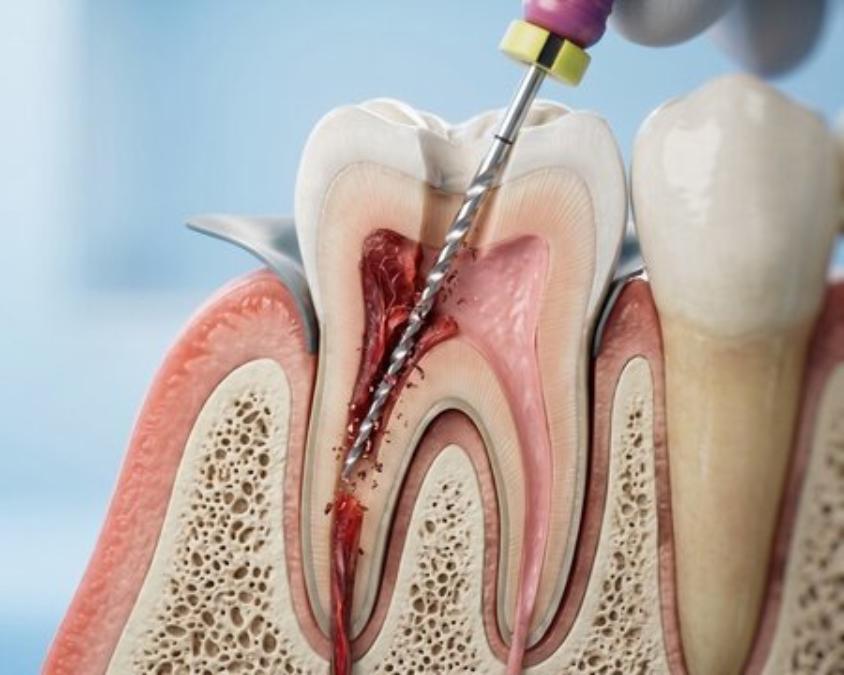
Root canal treatment is considered when the pulp — the soft tissue containing nerves and blood vessels inside the tooth — is irreversibly inflamed, infected or dead. Deep decay is a familiar cause, but it is hardly the only one. Cracks, repeated restorations, trauma and occasionally severe wear can produce the same end result.
The pattern of pain gives useful clues. A short, sharp response to ice that disappears immediately may not justify an RCT. Pain that continues well after the cold stimulus has been removed deserves closer attention. Heat sensitivity can be particularly troublesome in an inflamed pulp. Pain when biting may indicate inflammation around the root, although cracked teeth can behave in much the same way.
Night pain is another feature patients often describe. They lie down and the tooth begins throbbing.
Then there are teeth that stop hurting.
That is not always good news.
When the pulp dies, the intense sensitivity can disappear temporarily. Infection may continue around the root without much warning until swelling, tenderness or an abscess develops. A quiet tooth can still be an infected tooth.
A proper diagnosis before Root Canal Treatment in Maruthumkuzhi, Trivandrum should normally involve a clinical examination, pulp testing when appropriate, assessment of the gums and bite, and a suitable dental radiograph. In complex cases, three-dimensional imaging may be useful.
The mistake is treating an X-ray rather than treating a tooth. Radiographs are invaluable, but symptoms, examination findings and imaging have to make sense together.
What Actually Happens Inside the Tooth During RCT?
Root canal treatment has accumulated a rather undeserved reputation because patients tend to remember the infection that brought them to the dentist rather than the procedure used to remove it.
The basic objective is straightforward: gain access to the internal canal system, remove infected or irreversibly damaged tissue, disinfect the space, shape it sufficiently for cleaning and then seal it to reduce the chance of bacteria recolonising the canals.
Executing that properly is less straightforward.
Roots are not simple hollow tubes. Canals can curve sharply. They may divide and rejoin. Some are exceptionally narrow. Calcification can make a canal difficult to locate or negotiate. Upper molars commonly have several canals, including anatomy that can easily be missed without careful examination and magnification.
That is where the quality of endodontic work begins to separate.
Modern rotary and reciprocating instruments allow canals to be shaped more predictably than older hand-instrument-only approaches in suitable cases. Electronic apex locators help establish working length. Magnification improves visibility. Modern irrigation protocols are designed to disinfect areas that endodontic instruments cannot physically reach.
No file cleans every surface inside a root canal.
That point is sometimes lost in discussions about equipment. The instrument prepares space, but chemical disinfection is a major part of the treatment.
A rubber dam also deserves more attention than it usually receives. It isolates the tooth from saliva, improves visibility and reduces contamination while treatment is being performed. From a clinical perspective, it is not decorative equipment.
Patients looking for a Root Canal Dentist in Trivandrum are better served by asking how difficult cases are assessed, how isolation is handled, whether magnification is available when required and what happens after the root canal, rather than choosing solely on the basis of a advertised treatment price.
The final restoration matters almost as much as the root canal itself.
A technically good RCT under a poorly sealed restoration can still fail.
Posterior teeth, particularly molars and premolars that have lost substantial structure, may require a crown or another form of cuspal coverage after treatment. Root canal treatment does not automatically make every tooth brittle, as is sometimes claimed. Usually the larger problem is that the tooth was already heavily damaged by decay, old fillings, cracks or the access needed to treat it.
Preserving what remains is the real job.
Rotary Endodontics, Single-Visit Treatment and the Limits of “Advanced” Dentistry
The term “advanced root canal” gets used rather loosely.
A new machine does not turn a poorly diagnosed case into good dentistry.
What modern endodontics can do is make certain stages more controlled. Nickel-titanium rotary instruments are flexible enough to negotiate curved canals more safely than rigid stainless-steel files in many situations. They can produce a consistent canal preparation while reducing unnecessary removal of dentine when used appropriately.
Rotary instrumentation may also shorten the mechanical preparation stage.
It does not eliminate anatomy.
A very curved canal remains curved. A calcified canal remains difficult. A fractured instrument, perforation or previously missed canal can turn an apparently routine tooth into a much more complicated case.
The benefits of rotary endodontics are most obvious when the technology is combined with proper case selection, irrigation, working-length control and a clinician who knows when not to force an instrument further.
Single-visit treatment creates similar misunderstandings.
Single Visit Root Canal Treatment in Trivandrum can be entirely appropriate for selected teeth. If the canals can be cleaned, disinfected, dried and sealed satisfactorily during one appointment, there may be little value in splitting treatment unnecessarily.
That does not mean every infected tooth should be completed in one sitting.
Persistent drainage, significant infection, difficult anatomy, retreatment cases or certain symptomatic teeth may justify treatment over more than one appointment. Occasionally the sensible decision is to stop, place medication inside the canals and reassess.
Speed is useful only while clinical control is maintained.
A patient with a straightforward front tooth and a patient with a heavily restored upper molar containing four difficult canals are not undergoing the same procedure simply because both appointments are called RCT.
This also affects cost.
Searches for Affordable Root Canal Treatment in Trivandrum often compare headline prices without comparing the tooth involved, number of canals, complexity, imaging requirements, whether the case is a retreatment, type of final restoration or whether a crown is included.
The cheapest initial figure can become surprisingly expensive when treatment has to be repeated.
Equally, a high fee is not proof of superior endodontics.
The useful question is what the treatment actually includes.
Pain, Sensitivity and What Patients Commonly Get Wrong
Root canal treatment should not be performed simply because a tooth is sensitive.
Cold sensitivity is particularly misunderstood.
Suppose a patient drinks chilled water and experiences a sharp sensation lasting two seconds. Examination shows mild gum recession and an exposed root surface. Root canal treatment would be a disproportionate response.
Now take a different tooth. Cold produces severe pain that continues for half a minute or longer. The patient reports spontaneous episodes at night and cannot identify which tooth is causing them. A deep restoration is visible. That picture raises very different concerns.
Hot and cold sensitivity can indicate pulp inflammation, but the duration, intensity and spontaneity of symptoms matter.
A cracked tooth complicates things further. Cracks may create strange combinations of biting pain, release pain and temperature sensitivity. Some cracked teeth can be saved with root canal treatment and suitable restoration. Others cannot.
The crack decides more than the root canal.
If a fracture extends deep down the root or divides the tooth, removing the pulp will not repair the structural damage.
Patients also make a predictable mistake once antibiotics reduce swelling. The tooth feels better, so the treatment appointment gets cancelled.
Antibiotics can be useful when dental infection is accompanied by spreading swelling or systemic involvement, depending on the clinical situation. They do not mechanically clean an infected root canal. Once the medication is stopped, the source remains unless it has been definitively managed.
Painkillers create the same false sense of resolution.
Another common delay occurs when the tooth has been opened during an emergency appointment and temporarily dressed. The pain settles and the temporary filling remains for months. Temporary treatment was never meant to become permanent treatment.
After RCT, biting on the tooth before definitive restoration can create a different problem. A heavily weakened molar with a large temporary filling can fracture. Occasionally enough tooth remains to restore it. Sometimes the fracture makes extraction unavoidable.
Good endodontics cannot rescue every tooth.
Severe periodontal bone loss, vertical root fracture, decay extending too far below the gum, inadequate remaining tooth structure or an unfavourable crown-to-root situation can make extraction the more sensible option.
The aim of Root Canal Treatment in Maruthumkuzhi, Trivandrum should be to preserve a tooth that is genuinely restorable, not to perform RCT simply because a canal can technically be reached.
What Happens After Root Canal Treatment Matters More Than Patients Expect
A root canal appointment is not necessarily the end of treatment.
The tooth still has to function.
Immediately afterwards, mild tenderness when biting can occur for a few days, particularly if there was inflammation around the root before treatment. The sensation should generally move in the right direction rather than becoming progressively worse.
Significant swelling, severe increasing pain, fever or symptoms that do not settle deserve reassessment.
Patients sometimes interpret any post-treatment discomfort as proof that the procedure has failed. That is premature. Tissues around the root can remain inflamed even after the infected material inside the canal has been removed.
Healing takes time.
The opposite mistake is ignoring a tooth simply because it is painless.
A treated tooth should still be reviewed as advised, particularly when there was a visible lesion around the root before treatment. Bone healing is not instantaneous and may need radiographic follow-up.
Restoration cannot be treated casually either.
Front teeth with limited structural loss may need comparatively conservative restoration. A molar that has already lost several walls is different. Biting forces repeatedly flex weakened cusps until something eventually gives way. Appropriate cuspal protection may substantially improve the long-term prognosis in these cases.
There is also no credible promise that every root canal will last for life.
Well-treated and well-restored teeth can function for years, sometimes decades. Failure still occurs. A canal may have been impossible to locate. A complex anatomical branch may retain bacteria. The coronal restoration may leak. A new crack may develop. Occasionally disease persists despite apparently acceptable treatment.
Retreatment can sometimes preserve these teeth. Endodontic surgery is another option in selected circumstances. Extraction becomes appropriate when predictable restoration is no longer realistic.
That is the level at which Root Canal Treatment in Maruthumkuzhi, Trivandrum should be considered: not merely whether the nerve can be removed, but whether the complete treatment has a reasonable chance of leaving a useful tooth behind.
FAQ
What are the signs of a tooth infection requiring Root Canal Treatment?
Persistent toothache, prolonged sensitivity to heat or cold, pain while biting, tenderness around the tooth, gum swelling, a recurring pimple-like swelling on the gum, facial swelling or darkening of a tooth can all raise suspicion.
None of these signs proves that an RCT is required.
A dead pulp may produce almost no pain, while a sensitive tooth can sometimes have a perfectly recoverable pulp. Clinical testing and dental imaging are needed before the decision is made.
What is a Root Canal Treatment (RCT)?
RCT is a procedure used to treat infection or irreversible inflammation inside the pulp and root canal system of a tooth. The internal tissue is removed, the canals are cleaned and disinfected, shaped and then sealed.
The tooth is subsequently restored so that it can return to function.
What are the benefits of Rotary Endodontics?
Rotary nickel-titanium instruments are flexible and can prepare curved canals efficiently while creating a controlled shape for irrigation and filling.
They can reduce instrumentation time and improve consistency in suitable cases.
They still need careful use. Instrument separation, excessive dentine removal and procedural errors remain possible when files are forced or used without respect for canal anatomy.
How long does Root Canal Treatment take?
A straightforward tooth may sometimes be completed in a single appointment. Molars, complex anatomy, significant infection and retreatment cases can require longer appointments or multiple visits.
There is no clinically useful universal number of minutes for an RCT.
The tooth decides.
Is Root Canal Treatment safe?
Root canal treatment is a well-established dental procedure when it is appropriately diagnosed and carried out using accepted infection-control and endodontic protocols.
Medical conditions, medications, allergies and other relevant health information should still be discussed with the dentist before treatment.
Is Root Canal Treatment painful?
Modern local anaesthesia allows most root canal procedures to be performed with little or no pain during treatment. A tooth with severe acute inflammation can occasionally be more difficult to anaesthetise and may require additional anaesthetic techniques.
Some tenderness after treatment is possible.
Severe or increasing pain is not something a patient should simply tolerate for days without contacting the treating dentist.
Why choose Root Canal Treatment in Maruthumkuzhi, Trivandrum?
For patients living or working around Maruthumkuzhi and nearby parts of Thiruvananthapuram, local treatment can make repeat appointments, emergency reviews, restoration and follow-up more practical.
Location, however, should not be the only consideration. Diagnosis, isolation, canal disinfection, management of difficult anatomy and the quality of the final restoration have far more influence on the outcome.
What makes advanced Root Canal Treatment different from traditional RCT?
Current endodontic treatment may use rotary or reciprocating nickel-titanium instruments, electronic working-length measurement, improved irrigation techniques, magnification, digital radiography and, in selected difficult cases, CBCT imaging.
The difference is greater control and diagnostic information.
Technology cannot compensate for poor case selection or incomplete cleaning.
I've been experiencing tooth sensitivity to hot and cold. Will a Root Canal Treatment solve the problem?
Possibly, but sensitivity alone is not a reason to perform an RCT.
Brief cold sensitivity can arise from exposed dentine, gum recession, early decay or a restoration. Lingering pain after heat or cold, spontaneous pain and night pain are more suspicious for significant pulp inflammation.
The tooth needs to be tested before treatment is chosen.

Your Gateway to Healthy Smiles!
Guided by specialists. Built on trust.


© 2026 Trivandrum Smiles. All rights reserved.